Revealing Further Invisible Patterns
Beside Hair Tissue Mineral Analysis, there is a specific bloodwork that has the ability to bring very important underlying patterns into view—subtle shifts in mineral status and regulatory function that often go unnoticed,- yet have a profound impact on overall well-being.
When combined with Hair Tissue Mineral Analysis (HTMA), a more complete picture begins to emerge.
While these tests are not required to begin, they offer a level of clarity that allows for far more precise and individualized guidance. This combined perspective helps guide the process of restoring balance in a way that aligns with your body’s current state.
If you need support accessing these tests—wherever you are in the world—I’m here to make that first step simple and straightforward.
From there, the insights gained provide a clear starting point. With the right information in hand, the path toward renewed energy and resilience can begin to take shape clearly.
Essential Bloodwork & The Full Monty Iron Panel
This panel includes a carefully selected group of markers that help illuminate mineral dynamics within the body:
- Ceruloplasmin (Serum)
- Copper (Serum)
- Ferritin
- Hemoglobin
- Iron & TIBC
- Magnesium (RBC)
- Transferrin
- Uric Acid
- Vitamin A (Retinol)
- Vitamin D (Storage)
- Zinc (Plasma)
What the “Full Monty” Iron Panel Actually Is
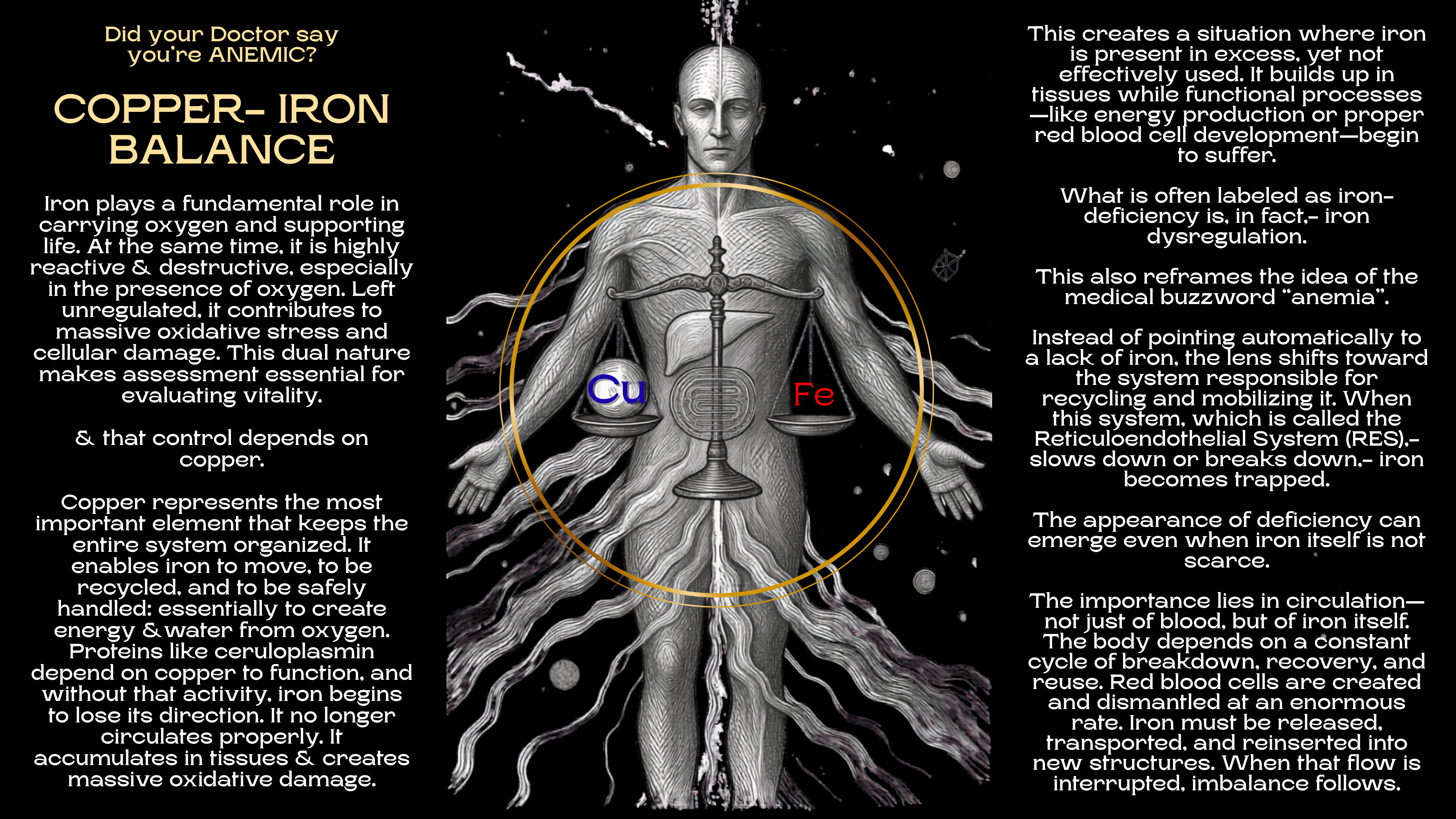
The Full Monty Iron Panel is a carefully assembled group of blood markers used to explore how iron is functioning within the body as a whole. Rather than relying on one or two isolated values, it brings together multiple indicators that reflect how iron is being stored, transported, and regulated.
In many standard settings, iron status is reduced to a small number of markers—often ferritin or serum iron alone. That narrow view can miss what’s actually happening, because iron is part of a much larger system. Its behavior depends on the optimal functioning of the Reticuloendothelial System (RES) which in it’s success or failure reflects how the human organism is able to create energy & clear exhaust!
The copper-iron metabolism is a highly important assessment to include whenever working on human vitality & the expression of health.
A Broader View of Iron
With this panel, the focus shifts toward understanding movement and regulation:
- How iron is being carried through the body
- Whether it is properly bound or left reactive
- How well regulatory proteins are doing their job
- What influence does copper have on the process
Iron plays a dual role in human physiology. It is essential for oxygen transport and energy production, yet it can also become highly disruptive (the number one source of oxidative stress!!!) when it is not properly managed.
Why This Panel Matters
Looking at these markers together allows patterns to surface that would otherwise remain hidden. Iron may appear sufficient while still not being effectively used. Storage levels can rise while transport or regulation struggles to keep up. In some cases, the system is less about deficiency and more about mismanagement. So before you blindly take iron supplements,- I highly encourage to contact me for clarification & guidance around this. & also to check out the Root Cause Protocol
This kind of interpretation depends on relationships between markers rather than isolated numbers.
How It Fits Into a Bigger Picture
When paired with HTMA, the Full Monty panel adds a more immediate snapshot to the longer-term patterns reflected in hair mineral analysis.
Blood markers show what is happening in the present moment, while HTMA reveals trends that have been developing over time. Seen together, they offer a more complete understanding of how the system is adapting and where it may need support.
The Full Monty Iron Panel helps trace how iron is being handled across the body—how it moves, where it accumulates, and how well it is regulated.